Product Development
How to Choose Fragrance for Skincare Products: A Guide for Private Label Brands
Learn how to choose fragrance for skincare products, from scent direction and formula compatibility to safety documentation, packaging and target-market requirements.
How to Choose Fragrance for Skincare Products: A Guide for Private Label Brands
Fragrance can shape a customer’s first impression of a skincare product. It can make a body lotion feel fresh, give a cleanser a recognizable identity or connect several products within the same collection.
However, a fragrance that smells appealing on a testing strip may perform differently in a finished formula. The base ingredients, product format, packaging and storage conditions all need consideration.
For private label skincare brands, choosing fragrance is a development decision involving the brand, formulator and fragrance supplier. This guide explains how to approach that decision before approving samples for production.
1. Decide What Role Fragrance Should Play
Start by deciding whether fragrance supports the product’s positioning and intended customer.
A fragranced body care collection may use scent as a central part of its identity. A facial moisturizer may call for a much quieter sensory experience. A range intended for fragrance-sensitive customers may be better developed without added fragrance.
Avoid choosing a scent simply because it is popular in another category. A fragrance that suits a shower gel may feel too noticeable in a facial cream used close to the nose.
Your initial brief should answer:
- Who will use the product?
- Where and how often will it be applied?
- Is it rinsed off or left on?
- Should the scent be barely noticeable or a defining feature?
- Will customers use it alongside other scented products?
These answers help the development team assess suitable options.
2. Match the Scent Direction to the Product Experience
Terms such as “fresh,” “clean” and “luxurious” can mean different things to different people. Give your manufacturer a more specific description and, where possible, a reference sample.
Describe both what you want and what you want to avoid.
For example:
A soft, fresh scent for a daily body lotion, with light floral notes and a subtle finish. Avoid strong sweetness and a long-lasting perfume effect.
The following directions can help organize a discussion. They are sensory starting points, not recommendations about ingredient suitability or safety.
Scent Direction | Possible Brand Experience | What to Clarify |
|---|---|---|
Fresh or aquatic | Light, crisp, refreshing | Whether it becomes too sharp in the formula |
Soft floral | Gentle, elegant, familiar | Preferred flowers and level of sweetness |
Green or herbal | Fresh, botanical, understated | Whether herbal notes dominate the base |
Fruity | Playful, bright, approachable | Whether the result feels fresh or candy-like |
Woody or musky | Warm, understated, sophisticated | Desired strength and lingering character |
Validate the direction with your intended customers where practical. Personal preferences within the development team may not represent the market.
3. Evaluate Fragrance in the Actual Formula
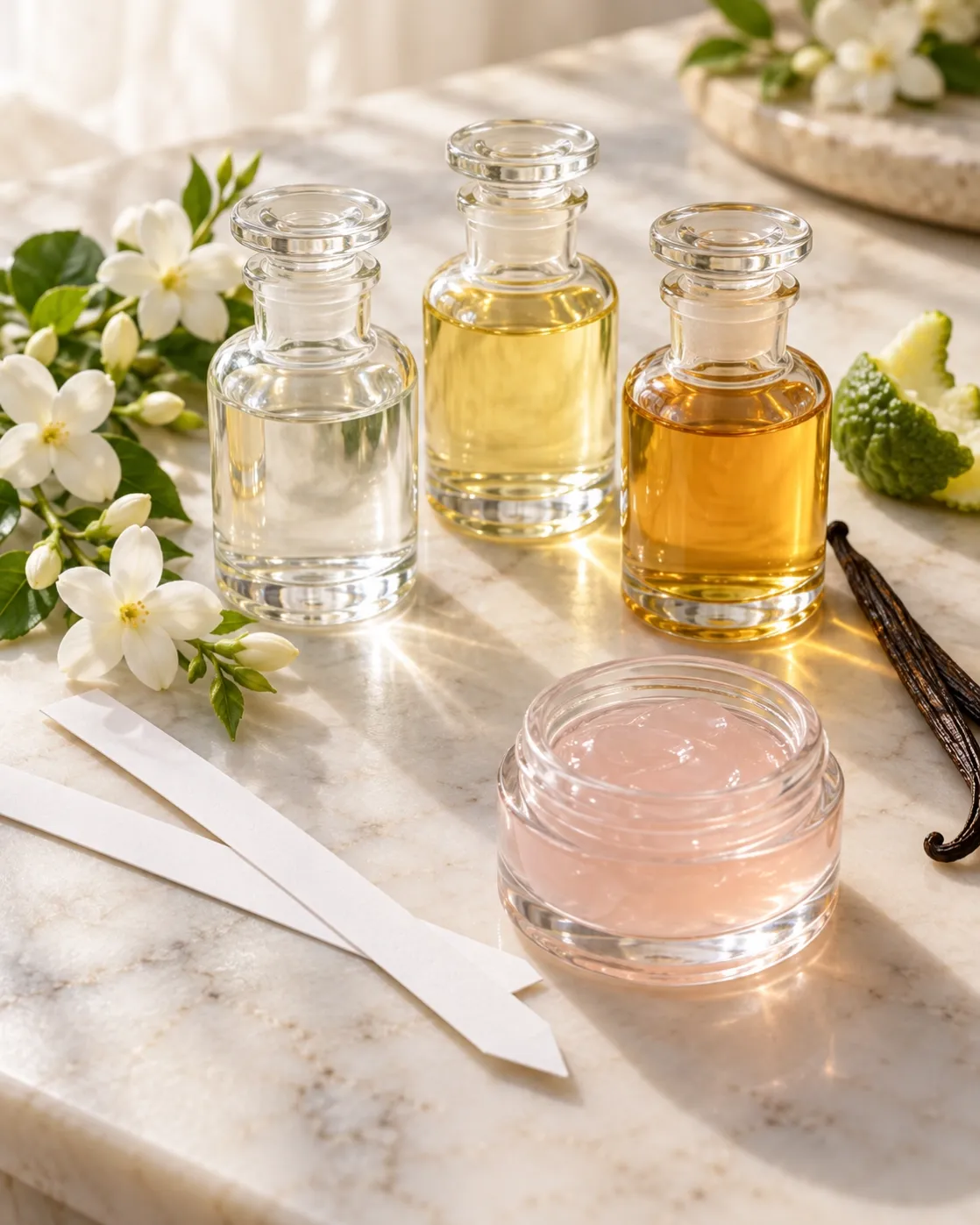
Testing strips are useful for an initial shortlist. Final selection should take place in the intended product base.
An emulsion, cleansing formula and oil-based product can present the same fragrance differently. The base may already have an odor from oils, extracts or other ingredients.
Ask for an unfragranced base sample alongside the fragranced versions. This helps you understand what the fragrance is contributing and whether it is interacting with an existing odor.
Evaluate the product at several relevant moments:
- When opening the package
- During application
- After spreading or rinsing
- After a consistent interval appropriate to the product’s use
Use comparable sample quantities and conditions. Record specific feedback such as “pleasant during application but too persistent afterward.”
A fragrance change should also be reviewed by the formulator for its effect on the complete formula.
4. Set the Use Level Through Technical Review
There is no single fragrance percentage suitable for every skincare product.
The appropriate level depends on the fragrance mixture, intended application, formula performance, safety assessment and applicable market requirements. Leave-on and rinse-off products should not automatically use the same fragrance level.
Request an IFRA Certificate of Conformity for the exact fragrance mixture and intended product use. Check the fragrance code, relevant use category and applicable limits with your supplier.
IFRA explains that conformity certificates are supplied by fragrance suppliers, rather than issued by IFRA itself. A certificate does not replace a finished-product safety assessment or compliance with local regulations. IFRA: Understanding the Standards
The maximum level stated for an intended use is a limit to consider, not a target dosage. The chosen concentration must also suit the product’s sensory and technical requirements.
Ask the development team to recommend suitable trial levels within the applicable constraints, then compare them in the finished base.
5. Compare Natural and Synthetic Options on Their Merits
Essential oils, natural aromatic extracts and synthetic fragrance materials each require an assessment appropriate to their composition and use.
“Natural” alone does not establish that a material is gentler or suitable for every application. The FDA notes that fragrance components can cause allergies or sensitivities in some individuals. IFRA also explains that essential oils may contain constituents subject to restrictions. FDA: Fragrances in Cosmetics, IFRA
Ask suppliers about composition, documentation, consistency, storage requirements and suitability for your product category.
If your brand has sourcing or ingredient policies, communicate them before the fragrance shortlist is prepared. This avoids approving an attractive scent that later conflicts with the product brief.
6. Understand “Fragrance-Free” and “Unscented”
An unscented product may contain ingredients added to mask the odor of the base. The FDA specifically highlights this distinction in its fragrance guidance. FDA
For a fragrance-free project, explain the intended claim to your manufacturer and have the complete ingredient composition reviewed against the destination market’s requirements.
A product without added fragrance may still have a noticeable raw-material odor. Decide during sampling whether that odor is acceptable for the intended customer.
Neither a mild smell nor the absence of a noticeable scent establishes product safety. Fragrance-free positioning also does not replace assessment of the complete formula.
7. Review Stability and Packaging Compatibility
Fragrance approval should include more than a fresh sample evaluation.
Ask the formulator to establish an appropriate stability and compatibility plan for the formula and final packaging. Depending on the product, observations may include:
- Changes in odor or fragrance intensity
- Discoloration
- Changes in clarity, texture or viscosity
- Separation or other signs of instability
- Leakage, deformation or changes in packaging materials
- Pump, cap or applicator performance
Evaluate the product in its intended packaging. An approval based only on a laboratory sample container does not address every question about the final pack.
If the fragrance changes after testing, the team should determine which evaluations need to be repeated before release.
8. Review the Destination Market Before Finalizing Labels
Provide the sales countries early in development. Fragrance restrictions and ingredient-labeling requirements can differ between markets.
For the European Union, Regulation (EU) 2023/1545 expanded individual fragrance-allergen labeling requirements. The European Commission states that relevant allergens must be declared when their finished-product concentrations exceed 0.001% in leave-on products or 0.01% in rinse-off products.
The transition deadline for placing products that do not meet the expanded requirements on the EU market was 31 July 2026. Qualifying products placed on the market before that date may continue to be made available until 31 July 2028. European Commission: Fragrance Allergen Labelling
These are labeling thresholds, not universal safety limits or permitted fragrance dosages.
Request current allergen information for the selected fragrance and assess contributions from other ingredients where relevant. Final artwork should reflect the approved formula and the requirements applicable at launch.
9. Confirm Supply and Reorder Consistency
A fragrance needs to remain commercially practical after the first order.
Before approval, confirm:
- Supplier and exact fragrance code
- Purchase MOQ and lead time
- Storage conditions and shelf-life information
- Availability of supporting documents
- Procedures for supplier changes or substitutions
- How an approved reference sample will be retained
If the same scent is used across several products, each formula still needs its own evaluation. Achieving a consistent sensory identity may require different development work for a cleanser, cream and body lotion.
Require confirmation before a fragrance substitution is made. Similar scent descriptions do not establish technical equivalence.
A Fragrance Selection Checklist
Before approving fragrance for production, make sure the project file answers the following questions:
Area | Approval Question |
|---|---|
Customer fit | Does the scent suit the intended customer and use occasion? |
Formula | Has it been evaluated in the actual product base? |
Intensity | Has the chosen level been technically reviewed and sampled? |
Documentation | Are the intended-use conformity and allergen documents available? |
Assessment | Have the finished-product assessment requirements been addressed? |
Stability | Has the fragrance been included in the appropriate testing plan? |
Packaging | Has the final formula been evaluated with the intended pack? |
Labeling | Does the artwork reflect the approved composition and market requirements? |
Supply | Are the fragrance code, availability and change procedures confirmed? |
The final approval should identify the fragrance code, concentration, formula version and packaging version. This gives both the brand and manufacturer a clear reference for production and reorders.
Develop Your Skincare Fragrance Brief with NUVION
NUVION supports fragrance selection and intensity refinement as part of skincare formula development, with fragrance-free options available.
Share your product type, target market, intended customer and scent references. Our R&D team can review the brief and discuss suitable fragrance options, sample evaluation and the documentation needed for the project.
Discuss Your Formula →
Frequently Asked Questions
Can the same fragrance be used in face and body products?
It may be possible, but suitability and use levels must be reviewed for each intended application. Each formula should also be evaluated for scent performance, stability and packaging compatibility.
How much fragrance should a skincare product contain?
There is no universal percentage. The level depends on the exact fragrance, intended use, applicable restrictions, finished-product assessment and formula requirements.
Can I choose fragrance from a testing strip?
A strip can help narrow the options. Final approval should be based on samples containing the fragrance in the intended formula.
Are essential oils always a safer alternative?
No. Suitability depends on the material’s composition, concentration, intended use and assessment. Natural origin alone does not establish safety.
Can fragrance be changed after formula approval?
A change may require revisions to the formula, testing, assessment and labeling. Confirm the implications with the development team before approving the replacement.
Does an IFRA Certificate of Conformity certify the finished skincare product?
No. It relates to the fragrance mixture for specified intended uses. It does not replace the finished-product safety assessment or applicable legal requirements. IFRA